Whatever: A Practical Look at This Handwritten Font for Approachable Design
When searching for a typeface that conveys warmth and personality, designers often find themselves weighing legibility against character. Whatever is a handwritten font that attempts to bridge this gap by offering a style that is quirky yet highly readable. It is not merely a collection of letters; it is a design tool specifically engineered to make visual content feel more human and less corporate. For adults managing personal projects, small businesses, or creative endeavors, understanding the nuances of Whatever can help determine if it is the right asset for your toolkit.
Defining the Character of Whatever
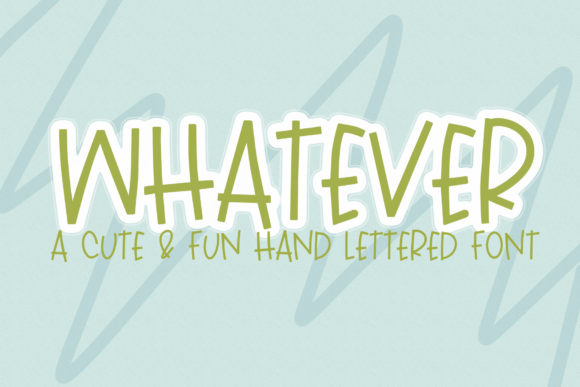
At its core, Whatever is defined by its playful geometry. Unlike rigid sans-serifs or overly formal serifs, this font mimics the organic inconsistencies of natural handwriting without sacrificing the clarity required for professional use. The design features soft, rounded edges and slightly uneven baselines, which contribute to its "childish" and approachable aesthetic. However, the term "childish" here should be understood as inviting rather than immature. It suggests a lack of pretension and an openness that resonates well with audiences looking for authentic connection.
The distinctiveness of Whatever lies in its balance. Many handwritten fonts fall into two traps: they are either so messy that they become illegible at small sizes, or they are so stylized that they look artificial. Whatever avoids both extremes. The letter spacing is generous, and the character shapes are consistent enough to ensure that a paragraph of text remains easy on the eyes. This makes it a strong contender for projects where the voice of the text is as important as the information it conveys.
Comparing Whatever to Other Typography Styles
To appreciate where Whatever fits, it helps to compare it to broader categories of typography. When you are evaluating fonts, you are generally choosing between serif, sans-serif, script, and display categories.
- Against Sans-Serifs: Standard sans-serifs like Helvetica or Arial are neutral and workhorse fonts. They disappear into the background. Whatever, conversely, is a foreground font. It adds flavor and tone. If a sans-serif is a plain white t-shirt, Whatever is a vintage band tee—it expresses a specific vibe.
- Against Traditional Scripts: Formal script fonts often mimic cursive calligraphy. While elegant, they can be difficult to read and often feel dated or overly fancy. Whatever is more casual and modern. It feels like a note passed between friends rather than a formal invitation to a gala.
- Against Other Handwritten Fonts: The market is saturated with handwritten options. Some are "grunge" and textured; others are marker-style. Whatever distinguishes itself by being "clean." It lacks the rough textures or ink bleeds found in other fonts, making it much more versatile for digital screens where clarity is paramount.
When deciding between Whatever and a more neutral option, consider the distance you want to create between your brand and the audience. Neutral fonts maintain a professional distance; Whatever closes that distance, creating a sense of intimacy.
Strengths and Ideal Use Cases
The primary strength of Whatever is its ability to disarm the reader. In a world of polished corporate messaging, a font that looks hand-drawn signals authenticity. This is particularly effective in specific scenarios.
Where Whatever Excels
Whatever is an excellent choice for user interfaces that require a friendly tone. Think of the onboarding screens for a meditation app, a grocery list manager, or a casual gaming interface. In these contexts, the font helps to lower the user's stress levels and makes the technology feel more accessible.
It is also highly effective for branding businesses that target families or creative consumers. Bakeries, daycare centers, boutique craft stores, and lifestyle blogs often benefit from this typeface. When used on a logo or a header, Whatever immediately communicates that the business is personable and customer-centric.
- Headlines and Titles: Because of its quirky nature, it draws attention effectively when used in larger sizes.
- Short Descriptive Text: Product descriptions or social media captions benefit from the added personality.
- Call-to-Action Buttons: Using Whatever on buttons can increase click-through rates by making the request feel less demanding.
Limitations and Tradeoffs
Despite its charm, Whatever is not a universal solution. The very quirks that make it lovable can become liabilities in the wrong context.
The most significant tradeoff is formality. You would not use Whatever for a legal disclaimer, a financial report, or a luxury brand aiming for exclusivity. Its casual nature could undermine the seriousness or prestige required for those topics. Furthermore, while it is more legible than many script fonts, it is still not optimized for long-form reading. Using Whatever for a 500-word blog post body would likely cause eye strain. The irregular shapes of the letters require more cognitive effort to process than standard print fonts.
Additionally, rendering can be an issue. Highly stylized fonts sometimes struggle with accessibility tools or older browsers. While Whatever is generally well-designed, it is always prudent to test how it renders across different devices to ensure the "fun" doesn't turn into "frustrating."
Making the Decision: Is Whatever Right for You?
Choosing a font is ultimately an exercise in empathy. You must consider how your reader will feel when they encounter your text. If your goal is to appear authoritative, traditional, or ultra-minimalist, Whatever is likely not the right fit. In those cases, a geometric sans-serif or a transitional serif would better serve your needs.
However, if your objective is to build a connection, evoke a smile, or present information in a way that feels like a conversation, Whatever is a strong candidate. It is particularly useful for designers who want to inject personality without sacrificing readability.
Consider the context of consumption. Is the user reading this on a mobile phone while standing in line? Whatever works well. Is the user reading this in a printed academic journal? You need something else.
Practical Application Tips
If you decide to implement Whatever, doing so effectively requires restraint. Because the font has such a strong personality, using it everywhere can be overwhelming.
- Pairing: Combine Whatever with a clean, neutral sans-serif for body text. For example, use Whatever for the main headline to grab attention, then switch to a font like Open Sans or Roboto for the paragraph text. This creates a hierarchy that guides the eye and prevents visual fatigue.
- Color and Background: Handwritten fonts like Whatever often look best on clean, solid backgrounds. Avoid placing them over busy photographs or complex patterns, as the irregular letterforms can get lost in the noise.
- Size Matters: Do not use Whatever at very small pixel sizes. The charm of the font is in the details of the curves and loops; if you shrink it too much, it will look like a blur rather than a style choice.
Final Thoughts on Evaluation
When evaluating Whatever against your checklist of requirements, treat it as a stylistic accent rather than a structural foundation. It is a font that adds flavor. If your design feels too sterile or cold, Whatever can provide the necessary warmth. If your design already has a lot of visual elements competing for attention, adding a quirky font might create chaos.
Ultimately, Whatever succeeds because it understands its purpose. It does not try to be everything to everyone. It offers a specific, well-executed aesthetic that is cute, fun, and functional. For designers navigating the balance between professional legibility and personal touch, it offers a compelling middle ground. By understanding its strengths and respecting its limitations, you can use Whatever to create designs that are not only visually appealing but also emotionally resonant.