Integrating Rumana: A Practical Guide to Folk Serif Typography in Modern Workflows
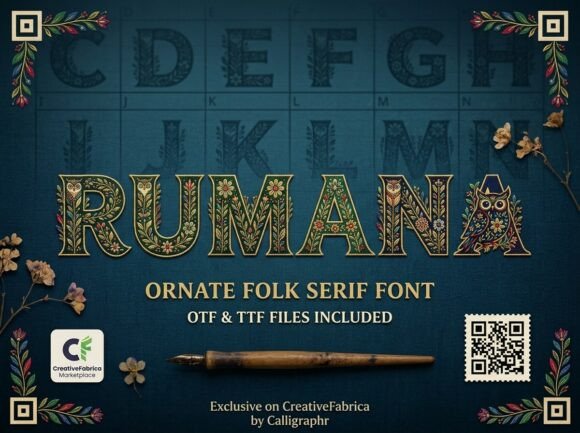
In the landscape of professional design and branding, typography often serves as the bridge between a concept and its execution. While minimalist sans-serifs dominate the digital interface, there is a persistent demand for typefaces that convey narrative, heritage, and tactile warmth. Rumana, an ornate folk serif font, answers this specific requirement. It is not merely a collection of letters but a dense tapestry of floral motifs and whimsical owls, rendered in a rich green, gold, and crimson palette. For designers, marketers, and creators, Rumana represents a specialized tool for projects where storytelling is paramount to the visual identity.
Understanding the Visual Architecture of Rumana
Before integrating any typeface into a project workflow, one must analyze its structural characteristics. Rumana is built upon the foundation of classic folk art and embroidery patterns. This means the letterforms are not uniform strokes; they are complex illustrations. Each glyph is densely packed with detail, mimicking the texture of hand-stitched fabric. The serif construction provides a traditional backbone, ensuring legibility despite the intricate ornamentation, but the character of the font is defined by its illustrative density.
The color palette—specifically the green, gold, and crimson finish shown in its presentation—is a critical factor in planning. While the font file itself is typically vector-based and can be recolored, the default aesthetic suggests a specific material context: luxury, winter holidays, or rustic elegance. When selecting Rumana for a workflow, you are committing to a high-visual-weight asset. It commands attention and fills negative space differently than a standard text font. Understanding this density is the first step in effective implementation, preventing the common error of using ornate typography in environments that require high-speed scanning or information retrieval.
Strategic Implementation: When to Deploy Rumana
The utility of a specialized font like Rumana is best understood through the lens of project phases. It is rarely a workhorse for body copy; instead, it is a strategic asset used during specific stages of the creative process.
Pre-Production and Concepting
During the mood-boarding and concepting phase, Rumana serves as a visual anchor for projects rooted in folklore or artisanal craftsmanship. If a small business owner is planning a rebrand for a tea company, a heritage bakery, or a boutique hotel, introducing Rumana early in the design deck helps set the tone. It signals to stakeholders that the brand voice leans toward the traditional and the hand-crafted. It acts as a proof-of-concept for "cozy" or "rustic" aesthetics before extensive design work begins.
Production and Asset Creation
During the execution phase, Rumana excels in headline and display applications. For publishers, it is an exceptional selection for book titles, particularly in the fantasy, fairy-tale, or historical fiction genres. The whimsical owls and floral elements embedded in the letters provide immediate genre signaling. In this context, the workflow involves kerning adjustments. Because the letters are ornate, the spacing between them often needs manual tightening to ensure the decorative elements don't create awkward gaps, maintaining a cohesive visual block.
Post-Production and Packaging
In the final stages of product development, specifically packaging design, Rumana offers a distinct advantage in shelf presence. For premium holiday packaging, the font’s intricate details suggest value and care. A workflow tip for print implementation is to ensure high-resolution rendering. Because the font mimics embroidery, low-resolution printing can cause the fine lines to blur or "bleed," losing the folk-art effect. It interacts heavily with paper stock; a textured, matte paper complements the simulated fabric feel, whereas a glossy finish might undermine the intended artisanal aesthetic.
Workflow Integration and Compatibility
Integrating a complex asset like Rumana into a broader toolset requires consideration of compatibility and efficiency. This font is best utilized within vector-based design software such as Adobe Illustrator or Affinity Designer, where the scalability of the intricate details is preserved.
When working within a team, consistency is key. If Rumana is chosen for a cultural branding project, it should be locked into the brand guidelines as a "Display" or "Accent" font only. It interacts with other resources best when paired with a clean, simple sans-serif or a standard serif for body copy. For example, using Rumana for a main headline on a poster, followed by a font like Roboto or Open Sans for the event details, creates a necessary hierarchy. This prevents visual fatigue and ensures the ornate nature of Rumana remains a highlight rather than a distraction.
For digital marketers and bloggers, performance is a factor. Because Rumana contains high-detail vectors, it can result in a larger file size compared to standard web fonts. If used on a website, it should be implemented as a static image for major headers or used via a highly optimized subset if served as a web font. The goal is to maintain page load speed while preserving the visual integrity of the folk art elements.
Practical Use Cases and Scenarios
To translate these concepts into actionable outcomes, consider the following scenarios where Rumana solves specific workflow problems.
- Cultural Event Branding: An educator or event planner organizing a folklore festival needs a visual identity that communicates tradition immediately. Using Rumana for the event logo and signage reduces the need for additional decorative graphics, as the typeface itself acts as illustration. This streamlines the design process by combining text and ornament into a single asset.
- Editorial Design: A publisher working on a collection of fairy tales can use Rumana for chapter headings. This establishes a whimsical rhythm for the reader. The workflow involves setting the font in large point sizes and potentially overlaying it on textured backgrounds to enhance the "storytelling" aspect of the layout.
- Product Packaging: A freelancer designing labels for a small-batch jam or artisanal soap can leverage Rumana to convey "homemade" quality. The font suggests that the product inside is as detailed and crafted as the label itself. This is a strategic decision to target a market segment that values aesthetic detail and heritage.
Quality Control and Long-Term Use
Effective use of Rumana involves quality control measures specific to its style. When finalizing a design, zoom in to check how the intricate motifs render at the intended size. If the font is reduced too much, the details may become muddy. It is generally unsuitable for footnotes, legal text, or any application requiring rapid reading.
Long-term, maintaining a library of assets that pair well with Rumana is beneficial. This includes stock photography featuring natural textures (wood, linen, stone) and color palettes that harmonize with the default green, gold, and crimson. By organizing these complementary assets, creators can quickly deploy Rumana in future projects without starting the aesthetic planning from scratch.
Ultimately, Rumana is a specialized instrument in the typographer’s toolkit. It is not a solution for every problem, but for projects requiring a specific voice—one of folklore, intricate craftsmanship, and rich narrative—it offers a level of detail and atmosphere that standard fonts cannot replicate. Its successful integration relies on respecting its complexity and using it to support, rather than overwhelm, the core message of the design.