Beyond the Ordinary: Understanding the Bold Impact of the Banak Display Typeface
In the vast digital landscape of typography, where thousands of serif and sans-serif fonts compete for attention, there exists a specific category of type designed not just to be read, but to be seen. Banak is a prime example of this philosophy. It is not merely a collection of letters; it is a visual statement. For designers, business owners, and content creators who find standard web fonts too restrictive or generic, Banak offers a refreshing departure. It is a decorative display font characterized by its unique artistic flair and strong personality, engineered to become the focal point of any composition it graces.
The Anatomy of Banak: What Makes It Unique?
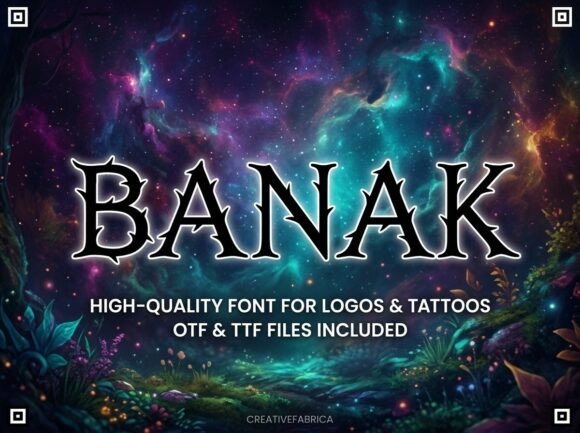
When we look at a font like Banak, we are looking at more than just geometry. This typeface is defined by its "stunning decorative" nature. Unlike utilitarian fonts such as Helvetica or Times New Roman, which are designed for long-form reading and body text, Banak is crafted for impact. Its visual personality is distinct, featuring artistic elements that give each letterform a sense of weight and importance. This makes it an ideal choice for creators who want to break away from the ordinary and inject a sense of exclusivity into their designs.
The primary characteristic of Banak is its function as a display typeface. In typography, "display" refers to fonts intended for use at large sizes—think headlines, posters, and logos—rather than small body text. Banak excels in this environment because its intricate details and bold structure become fully apparent when scaled up. It commands attention, making it a powerful tool for visual hierarchy.
The Technical Foundation: OTF and TTF Files
For the modern creative professional, versatility in file format is crucial. When you integrate Banak into your workflow, you are provided with the industry-standard files necessary for seamless implementation:
- OTF (OpenType Font): This is the professional standard for advanced design and layout software. The OTF format for Banak allows for more sophisticated typographic features and is the preferred choice for designers using high-end software like Adobe Creative Suite.
- TTF (TrueType Font): Universality is key in a multi-device world. The TTF version of Banak ensures standard compatibility across all devices and operating systems, ensuring that your design retains its integrity whether viewed on a Mac, PC, or mobile device.
A Critical Design Consideration: The All-Caps Aesthetic
Before integrating Banak into a project, it is vital to understand its specific design constraints, as these define how it should be used. Banak is an ALL-CAPS Uppercase Only display typeface.
This is a deliberate stylistic choice, not a limitation. By focusing exclusively on uppercase letters, the designer of Banak has ensured that every letter is treated as a standalone work of art. In many decorative fonts, lowercase letters can feel like afterthoughts—simply smaller versions of the capitals. Banak avoids this by dedicating its entire design energy to the uppercase alphabet. This results in a cohesive, powerful look where "every letter is a work of art."
However, this characteristic dictates how you should plan your content. Because Banak does not include lowercase letters, it is not suitable for writing paragraphs, emails, or long-form articles. Attempting to write a full sentence in body text using Banak would likely result in readability issues. Instead, its strength lies in brevity and impact.
Practical Applications: Where Does Banak Shine?
The versatility of Banak allows it to adapt to various creative industries. Its professional finish ensures that while it is artistic, it does not look amateurish. Here are some real-world scenarios where Banak adds significant value:
- Bold Headlines and Titles: The most immediate use for Banak is in headlines. Whether for a blog post, a magazine cover, or a landing page, Banak grabs the reader's eye instantly. Its strong visual weight ensures that the main message is communicated before the user reads anything else.
- Artistic Logos and Branding: A logo needs to be memorable. For brands in the fashion, entertainment, or lifestyle sectors, Banak provides a distinct voice. It suggests creativity and confidence. A logo set in Banak tells the audience that the brand is bold and unafraid to stand out.
- Creative Packaging: In the retail space, shelf appeal is everything. Banak is perfect for product packaging where the name of the product needs to pop. It works exceptionally well on merchandise, apparel tags, and boutique packaging where the aesthetic is as important as the product itself.
- Decorative Initials: Even in text-heavy designs, Banak can play a role. Using it for decorative initials (drop caps) at the beginning of a chapter or article can add a touch of elegance and break up the monotony of standard text.
Evaluating Suitability: Is Banak Right for Your Project?
While Banak is a powerful tool, it is not a one-size-fits-all solution. Evaluating whether this font fits your project requires an honest assessment of your goals and audience.
Strengths
The primary strength of Banak is its ability to convey emotion and style instantly. It bridges the gap between "professional" and "artistic." Many fonts are either too sterile for creative work or too chaotic for business use; Banak sits in a sweet spot, offering a polished finish that respects professional standards while embracing artistic expression.
Limitations and Expectations
The most obvious limitation is the lack of lowercase letters. If your project requires typing out full addresses, descriptions, or disclaimers, you will need a secondary font to pair with Banak. It is best to view Banak as a highlight font—used for the big moments—paired with a clean, legible sans-serif for the supporting information.
Additionally, because it is a display font, it may not render well at very small sizes (below 12pt). The artistic elements that make it beautiful at large sizes can become muddy or illegible when shrunk down for footnote usage.
Guidance for Implementation
To get the most out of Banak, consider the following workflow:
- Pairing Fonts: Combine Banak with a neutral, geometric sans-serif font. This contrast allows Banak to be the "star" of the show while the secondary font handles the heavy lifting of information delivery.
- Spacing and Kerning: Because Banak features unique artistic elements, pay close attention to letter spacing (tracking). Display fonts often benefit from slightly looser tracking to let the artwork of each letter breathe.
- Color and Contrast: Banak looks best when there is high contrast. Whether it is white text on a dark background or a vibrant color against a neutral backdrop, ensure the font stands out clearly.
Conclusion
Banak is more than just a file to install; it is a creative asset designed to elevate visual communication. By understanding its all-caps nature and its purpose as a display typeface, creators can leverage Banak to produce designs that are bold, professional, and undeniably artistic. Whether you are designing a logo for a new startup, crafting a headline for a poster, or packaging a luxury product, Banak provides the visual personality needed to leave a lasting impression.