Ignite Your Visual Identity: Mastering the Art of Intensity with Karim
In the crowded digital landscape, attention is the most valuable currency. Whether you are a game developer launching a new title, a chef branding a spicy new hot sauce, or a band releasing a debut album, the first visual impression often determines whether a potential customer stops scrolling or keeps moving. While minimalist design has dominated the last decade, there is a powerful counter-trend emerging in creative circles: the return of texture, depth, and raw emotion. This shift demands tools that do more than just arrange letters; they need to convey a specific, visceral feeling instantly. This is where the concept of visual identity becomes critical, moving beyond simple logos to create an atmosphere that audiences can almost feel.
The challenge for many creators and marketers lies in finding typography that bridges the gap between professionalism and raw energy. Standard sans-serifs often feel too corporate or sterile for high-octane projects, while generic decorative fonts can look amateurish. Karim enters this space as a distinct solution, offering a specialized aesthetic that combines structural integrity with chaotic beauty. It represents a new breed of typeface design that leverages modern rendering technology to offer something previously impossible: a font that looks like it is physically burning. Understanding how to utilize such a specialized tool is key for anyone looking to stand out in industries like gaming, entertainment, and food branding.
The Anatomy of Karim: Structure Meets Chaos
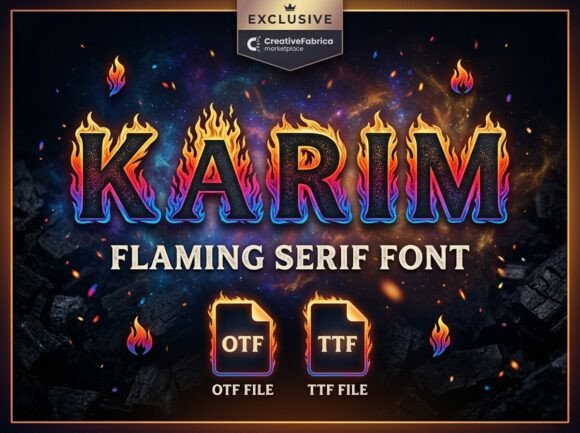
To understand the utility of Karim, one must first look at its construction. At its core, this is a serif typeface, meaning it retains the traditional "feet" and structural stability associated with classical typography. Serifs have long been trusted for their readability and their association with authority and tradition. However, Karim subverts this expectation by applying hyper-realistic fire and ember textures to these classic foundations. The result is a typeface that feels grounded yet volatile. It does not sacrifice legibility for the sake of style; rather, it uses the sturdy skeleton of a serif to support a complex, fiery overlay.
This design philosophy is particularly relevant in an era of hyper-realism in digital art. With the advent of high-resolution screens and advanced rendering engines, audiences are accustomed to seeing intricate details. A flat, vector-based logo can sometimes feel lacking in depth when viewed on a 4K smartphone screen. Karim addresses this by incorporating textures that mimic the behavior of real fire—flickering edges, glowing coals, and the interplay of light and shadow. For a graphic designer or a freelancer, this means the font itself does half the heavy lifting in establishing a mood. It provides a "cinematic" quality that would otherwise require hours of manual photo manipulation to achieve.
Current Trends: Why High-Energy Branding is Resurging
For years, the "flat design" trend reigned supreme, stripping away gradients and shadows in favor of clean lines and solid colors. While effective for corporate tech companies, this approach often falls short for brands trying to express passion, danger, or excitement. We are currently witnessing a market correction where consumers crave authenticity and emotional resonance. In the gaming industry, for example, the aesthetic has moved toward gritty realism and immersive environments. Similarly, in the culinary world, the "spicy" food market has exploded, requiring branding that visually communicates heat and flavor intensity before the consumer even tastes the product.
Karim fits perfectly into this shift. It is not merely a font; it is a thematic asset. Consider the heavy metal genre, where visual identity is almost as important as the music itself. The aesthetic relies heavily on themes of fire, darkness, and intensity. A standard blackletter font might suffice, but Karim offers a modern, textured alternative that feels more immediate and visceral. For entrepreneurs and business owners in these niche markets, using a typeface like Karim signals that the brand understands the culture and the specific expectations of its audience. It bridges the gap between traditional branding and the immersive experiences modern consumers demand.
Practical Applications for Creators and Professionals
The versatility of Karim lies in its specific targeting of high-energy sectors. While it may not be suitable for a law firm’s letterhead, it is an indispensable tool for specific creative workflows. Here is how different professionals can leverage this typeface:
- Gaming and Esports: In the competitive world of esports, team logos and stream overlays need to be instantly recognizable. Karim provides a "fire" element that is often sought after in shooter or battle royale game aesthetics. It can be used for title cards, kill feeds, or merchandise to create a cohesive brand identity that radiates dominance.
- Food and Beverage Branding: Packaging design for hot sauces, barbecue rubs, and spicy snacks relies on visual cues to communicate flavor. The burning texture of Karim acts as a subconscious signal of heat. It allows designers to create labels that pop off the shelf without needing complex illustration work surrounding the text.
- Music and Entertainment: Beyond heavy metal, any genre looking to project an image of rebellion, energy, or "heat" (such as trap or EDM) can benefit from this style. Album covers, concert posters, and social media graphics require high-impact visuals that look good even as small thumbnails on streaming platforms.
- Cinematic Projects: For movie posters, particularly in the action, thriller, or horror genres, typography sets the tone. Karim offers a look that suggests danger or supernatural power, making it ideal for titles that need to grab a viewer’s attention immediately.
Adapting to Modern Workflows
One of the practical considerations for modern creators is workflow efficiency. Historically, achieving the effect seen in Karim required a multi-step process: selecting a base font, creating a fire texture, warping the texture to fit the letters, and manually adjusting the lighting. This process is time-consuming and requires a moderate level of skill in photo editing software. By using a pre-rendered texture font like Karim, designers can significantly speed up their production time. This is crucial for freelancers and agencies working on tight deadlines who still need to deliver high-quality, bespoke-looking assets.
Furthermore, the rise of social media content creation has democratized design. Influencers and content creators often manage their own branding. Tools that simplify complex visual effects are highly valuable. While Karim is a professional tool, its visual nature makes it accessible. A YouStreamer or a podcaster can use it for their channel art to quickly establish a "fiery" brand personality without needing to hire a specialized 3D artist.
Visual Psychology and Consumer Perception
There is a psychological component to why a font like Karim is effective. Color theory and texture play significant roles in consumer behavior. Red, orange, and yellow are colors associated with urgency, appetite, and excitement. When these colors are presented in the form of fire, the associations become even stronger, evoking feelings of warmth, danger, or passion. In branding, this can be used to trigger an emotional response. A gaming logo using Karim subconsciously tells the viewer that the game is fast-paced and intense. A food brand using the font suggests a product that is bold and not for the faint of heart.
It is also important to discuss the concept of "visual noise" versus "visual interest." A common mistake in design is adding elements that clutter without adding value. However, Karim manages to add significant visual noise—fire and embers—while maintaining the structured legibility of a serif font. This balance is difficult to strike. It allows the text to be decorative without becoming unreadable, provided it is used at appropriate sizes. For marketers, this means you can create a "loud" design that still communicates clearly.
Recommendations for Usage
Because Karim is a highly stylized display font, it requires a thoughtful approach to implementation. It is not designed for body copy or long paragraphs; the intricate textures would become muddy and difficult to read at small sizes, and the visual intensity would overwhelm the reader. Instead, it should be reserved for headlines, logos, and short, impactful callouts.
When pairing Karim with other typefaces, contrast is key. A clean, geometric sans-serif works well as a secondary font for subheadings or body text. This allows the fiery nature of Karim to stand out without competing with other decorative elements. Additionally, consider the background. A dark, high-contrast background (such as deep charcoal or black) will make the fire textures of Karim glow and pop, simulating the effect of embers in the dark. Conversely, using a busy, light-colored background might dilute the impact of the font's details.
The Future of Thematic Typography
The existence of fonts like Karim points toward a broader trend in the creative market: the move toward experiential design. As augmented reality (AR) and virtual reality (VR) technologies become more mainstream, the demand for textures that mimic real-world materials will likely grow. We are moving away from the purely digital, flat aesthetic and toward a digital world that feels tactile. Typography that incorporates realistic textures is a precursor to this shift, grounding digital text in a sense of physical reality.
For creators, educators, and business owners, the lesson is clear: visual identity is about aligning every element of your design with the core emotion of your message. If your message is about stability and tradition, you choose a classic serif. If your message is about energy, heat, and intensity, you need a tool that embodies those traits. Karim is not just a font; it is a strategic asset for brands that refuse to be ignored. By understanding the psychology behind the design and applying it to the right contexts, you can transform a standard project into a burning statement of intent.