The Psychology of Playful Typography: Analyzing the Fox Orbit Bubble Font Family
In the landscape of graphic design, typography serves as the voice of the visual medium. While serif fonts whisper tradition and sans-serifs shout modernity, there is a specific category of typefaces that screams pure, unadulterated joy: the bubble font. Among the contemporary offerings in this niche, the Fox Orbit font family stands out as a prime example of how digital design can emulate tactile, three-dimensional playfulness. This article explores the structural anatomy, psychological impact, and practical application of Fox Orbit, providing a comprehensive guide for designers, educators, and brand managers looking to harness the power of whimsical typography.
Anatomy of a Bubble Font: Understanding the Fox Orbit Structure
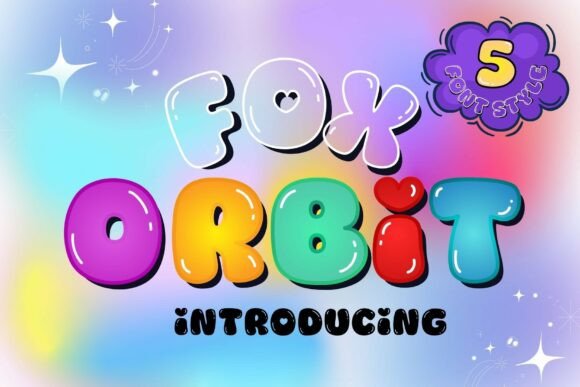
To appreciate the utility of Fox Orbit, one must first understand its construction. Unlike standard geometric sans-serifs that rely on rigid grid systems, Fox Orbit utilizes an ultra-rounded anatomy that mimics the physics of inflated objects. The terminals of the letters are sealed, and the negative space (counters) inside letters like 'O', 'A', and 'B' is often minimized to create a sense of density and buoyancy.
A defining characteristic of the Fox Orbit family is its glossy highlight details. In traditional design, fonts are flat vectors. However, Fox Orbit integrates highlight effects directly into the glyph design or offers styles that suggest a reflective surface. This creates an immediate illusion of depth, making the text appear as though it is made of vinyl, plastic, or rubber. For a designer, this eliminates the need for complex layering or 3D rendering software to achieve a "pop" effect; the font does the heavy lifting.
The family offers five distinct styles, allowing for versatility within a single visual theme. While the classic bubble style provides the standard inflated look, variations such as heart-accented styles allow for thematic customization. This modular approach ensures that the font can adapt to different emotional tones—from the chaotic energy of a video game to the affectionate warmth of a greeting card.
The Psychology of "Roundedness" in Visual Communication
Why does a font like Fox Orbit feel inherently "fun"? The answer lies in shape psychology. Research in consumer behavior suggests that rounded shapes are associated with safety, softness, and approachability. Sharp corners, conversely, can trigger subconscious associations with danger or precision. When a user encounters the ultra-rounded forms of Fox Orbit, the brain processes it as non-threatening and friendly.
This psychological trigger is vital for specific industries. For example, in the realm of children’s toys packaging, the goal is to attract attention while assuring safety. The inflated look of Fox Orbit suggests a softness that appeals to both parents and children. It signals that the product is designed for play, not for serious adult utility. Similarly, in mobile gaming titles, particularly those in the casual or hyper-casual genre, rounded typography helps lower the barrier to entry for new players, suggesting that the game mechanics will be intuitive and forgiving.
Practical Applications: Where Fox Orbit Shines
While the aesthetic is specific, the use cases for a high-energy bubble font are surprisingly diverse. The key is understanding the context of the message.
Event Branding and Invitations
The most immediate application for Fox Orbit is in event stationery. Birthday party invitations benefit significantly from this style. The font captures a "Saturday-morning-cartoon energy" that instantly sets the tone for a celebration. When used on digital invites or printed cards, the glossy finish of the font pairs well with high-gloss paper stock or digital screens, creating a cohesive tactile experience.
Confectionery and Food Packaging
The food industry, particularly the candy sector, relies heavily on visual appetite appeal. Candy brand logos often use reds, yellows, and oranges to stimulate hunger. Fox Orbit complements these palettes perfectly. The font looks as though it could be made of taffy or bubblegum. It suggests sweetness and indulgence. A design using Fox Orbit for a gummy bear brand, for instance, would instantly communicate the chewy texture of the product.
Digital Interfaces and UI Elements
Beyond logos, Fox Orbit is effective for user interface (UI) elements in gamified apps. Buttons, achievement badges, and "Level Up" notifications require typography that is legible at a glance but distinct from standard body copy. The bold weight and distinct silhouette of Fox Orbit make it excellent for call-to-action (CTA) buttons where the goal is to encourage a click through positive reinforcement.
Design Considerations: Balancing Energy with Usability
While Fox Orbit is a powerful tool for expression, it requires a disciplined approach to typography. Because of its highly stylized nature, it is not a "set it and forget it" solution for all text elements.
Readability and Hierarchy
Bubble fonts can become difficult to read in long sentences or at small sizes due to the thick strokes and tight spacing often associated with the style. Therefore, Fox Orbit should be reserved for headlines, logos, and display text. It is not recommended for body copy or lengthy instructions. Designers should pair Fox Orbit with a clean, simple sans-serif font for secondary information to maintain legibility while preserving the playful theme.
Color Theory and Contrast
The "glossy" nature of Fox Orbit implies volume. To enhance this, designers should consider using gradients or solid, bright colors. Dark, muted tones can sometimes flatten the effect of a bubble font. Furthermore, contrast is critical. If the background is complex, the text may get lost. High-contrast backgrounds—such as a clean white space or a solid bright color—allow the intricate details of the Fox Orbit letters to stand out.
Spacing and Kerning
Due to the roundness of the characters, bubble fonts often appear wider than standard fonts. When working with Fox Orbit, tracking (letter spacing) may need to be adjusted manually. In headlines, tightening the kerning slightly can help the letters "hug" each other, enhancing the inflated, tactile feel. However, over-tightening can cause the highlights of adjacent letters to clash, so careful visual inspection is required.
The Nostalgia Factor: Why "Saturday Morning" Matters
The prompt for Fox Orbit mentions "Saturday-morning-cartoon energy." This is a specific emotional resonance that leverages nostalgia. For millennial and Gen Z audiences, this aesthetic recalls a time of low-stakes entertainment and vibrant colors. By utilizing Fox Orbit, a brand can tap into this reservoir of positive sentiment.
This is particularly relevant for retro-themed products or brands trying to bridge the gap between generations. A toy manufacturer releasing a reissued classic toy might use Fox Orbit to signal that the product retains its original fun spirit, even if the materials and safety standards have been modernized. The font acts as a visual bridge to the past.
Technical Versatility: The Five Styles
The inclusion of five distinct styles within the Fox Orbit family offers significant technical advantages for comprehensive branding systems. A single font family that can cover different moods prevents the design from becoming monotonous.
- Classic Bubble: The workhorse of the family. Best for primary logos and main headings where the standard "inflated" look is required.
- Heart-Accent Variations: These styles are ideal for secondary applications, such as "I Love You" messages, Valentine’s promotions, or highlighting specific keywords in a sentence without changing the font family.
- Weight Variations: Depending on the specific configuration of the five styles, varying weights allow for emphasis. A bolder weight can be used for the brand name, while a slightly lighter (though still bubbly) weight can be used for taglines.
This versatility ensures that a designer can create a cohesive visual identity using only one font family, reducing load times for web projects and simplifying style guides for print.
Conclusion: The Strategic Value of Whimsy
In a digital landscape often dominated by minimalism and sharp edges, Fox Orbit offers a necessary counterbalance. It is a reminder that design can be tactile, soft, and joyful. Whether applied to the packaging of a new candy bar, the title screen of a mobile puzzle game, or the invitation to a child’s birthday party, Fox Orbit serves a specific strategic purpose: to disarm the viewer and invite them to play.
For designers and creators, the lesson is clear. Typography is not just about legibility; it is about texture and emotion. By understanding the anatomy and psychology behind fonts like Fox Orbit, professionals can make more intentional choices that resonate deeply with their target audiences. In the right context, a bubble isn't just a shape; it's a promise of fun.