China: A Knightly Display Font for Legendary Designs
In the world of digital design, typography is more than just arranging letters; it is the voice of your visual message. When the goal is to convey strength, history, and nobility, standard sans-serifs often fall short. This is where specialized typefaces come into play. Enter China, a premium knightly display font designed to capture the very essence of chivalry and ancient power. For designers seeking to create a monumental impact, China offers a unique visual language rooted in medieval lore and architectural precision.
Understanding the Essence of China Typography
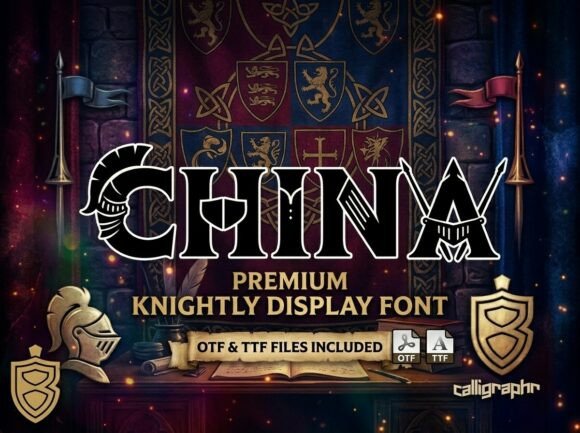
At its core, China is a display typeface, meaning it is crafted specifically for large-scale usage such as headlines, logos, and titles rather than body text. What sets this font apart is its integration of warrior iconography directly into the letterforms. The design philosophy behind China draws heavily from the aesthetics of the battlefield and the castle. The glyphs feature bold, monumental structures that mimic the weight and presence of stone fortifications or heavy armor.
The defining characteristic of the China font is the incorporation of medieval motifs. You will notice that the serifs and terminals are designed to resemble elements of armor. Specifically, the font integrates Spartan-style helms, knightly shields, and crossed spears into the architecture of the letters. This is not merely a decorative overlay; the structural integrity of the font is built around these elements. This creates a seamless blend of readability and thematic illustration, allowing the text to serve as both a word and a symbol of valor.
The Challenge of Conveying Historical Weight
Designers working on historical or fantasy projects often face a significant challenge: authenticity without sacrificing modern usability. Many "medieval" fonts available today can look cartoonish, overly complex, or difficult to read. They may use jagged edges or distressed textures that become illegible at smaller sizes or when printed on textured materials.
The goal for a project involving a royal heritage theme or an epic gaming title is to evoke a sense of legendary valor while maintaining clarity. A designer needs a typeface that feels "ancient" and "powerful" but operates with the precision of modern vector graphics. The need is for a font that commands attention immediately, suggesting a backstory of battles, royalty, and myth before the viewer even reads the definition of the text. China addresses this gap by offering architectural precision, ensuring that the heavy visual weight of the font does not compromise the legibility of the headline.
Practical Applications of the China Font
The versatility of China lies in its ability to adapt to various high-stakes creative environments. Because it is a display font, it is best utilized where impact is the primary metric of success.
Epic Gaming and Esports
In the gaming industry, first impressions are vital. The title screen of a strategy game or a role-playing game (RPG) sets the tone for the entire player experience. China is exceptionally suited for this environment. It can be used for main menu titles, faction logos, or expansion pack headers. For a game set in a "fantasy underworld" or a high-fantasy kingdom, the font provides an immediate visual shorthand for combat, strategy, and heroism. The integrated spear and shield motifs suggest gameplay mechanics before the user even clicks "Play."
Cinematic Branding and Movie Posters
Movie posters for historical epics or action blockbusters rely on typography to bridge the gap between the cast list and the film's atmosphere. Using China for the title treatment of a historical novel adaptation or a sword-and-sorcery film can help establish the genre instantly. The bold letterforms stand out against dark, moody backgrounds often used in cinematic key art, ensuring the title remains the focal point.
Heraldic Branding and Events
Beyond entertainment, China has practical applications in event branding. Consider a medieval fair, a historical reenactment society, or a high-end menswear brand focusing on rugged, heritage aesthetics. In these contexts, the font can be used for signage, merchandise, and digital marketing. It delivers a sense of "ancient power" that aligns perfectly with brands wanting to project stability, tradition, and resilience.
Implementing China in Your Design Workflow
To get the most out of China, designers should approach the font with a strategy that highlights its unique features without overwhelming the viewer. Here are several recommendations for effective implementation.
- Pairing with Simplicity: Because China is rich in detail and texture, it pairs best with clean, simple sans-serif fonts for body text. A geometric sans-serif can provide a modern contrast that makes the medieval style of China pop without making the design feel cluttered.
- Color and Texture: This font thrives in environments that mimic physical materials. Consider using metallic gradients (gold, silver, bronze) or stone textures within the letters to emphasize the armor motifs. Dark backgrounds often work best to let the intricate details of the letterforms shine.
- Spacing and Leading: Due to the bold nature of the font, ensure there is adequate letter-spacing (tracking) to prevent the characters from colliding, especially with the integrated motifs. Generous leading helps maintain the "monumental" feel of the headline.
Tailoring the Approach for Different Users
Different users will interact with the China font depending on their specific goals.
For the Indie Game Developer: The focus is likely on immersion. You might use China not just for the logo, but for in-game UI elements like faction names or location markers on a map. The goal is to create a cohesive world where the typography itself feels like an artifact of the game's history.
For the Book Cover Designer: The priority is shelf presence. Here, China should be used strictly for the title to maximize impact. The designer might focus on kerning (the space between specific pairs of letters) to create a perfect silhouette for the cover, ensuring the title is readable even as a small thumbnail on an e-commerce site.
For the Event Planner: Usability in print is key. When printing on banners or flyers, the bold strokes of China ensure that the text remains legible from a distance. The user might focus on single-color applications, such as gold foil on black cardstock, to leverage the font's regal aesthetic.
Considerations for Web and Mobile
If you intend to use China on a website, performance is a consideration. Since display fonts can be heavier in file size than standard web fonts, it is advisable to use it only for specific hero text or H1 headers. This ensures the site loads quickly while still delivering that initial "wow" factor to the visitor. Using CSS to control the rendering of the font can help maintain the crispness of the armor motifs on high-resolution screens.
The Value of Thematic Consistency
Ultimately, the power of China lies in its ability to unify a design theme. In branding, consistency is what builds trust and recognition. When a user sees a header rendered in China, they immediately understand the tone of the content. They expect something grand, historical, or adventurous.
By choosing a font that carries such strong semantic weight, you are doing half the communicative work before the audience reads a single sentence. China is not just a collection of glyphs; it is a tool for storytelling. Whether you are designing for a "royal heritage project" or a digital fantasy realm, this typeface provides the visual foundation necessary to build a world of legendary valor and ancient power.